Showing posts with label experience. Show all posts

Saturday, 14 August 2021

Patient Story - Ledderhose patient from Australia

Today I have some information from a patient in Australia that I connected with on Facebook, they have had surgery and some injections and are hoping for some more injections.  


My name is Janine, I am 48 and live in Melbourne, Australia. I first noticed a lump on the arch of my foot at the age of 41 and was referred to a Podiatrist. His advice was to get orthotics, so I had some orthotics made which worked great for when I was wearing trainers but they were too thick for any other types of shoes. I was advised to monitor its size with regular ultrasounds. The first ultrasound also found smaller fibromas in my other foot.
I then took on a new job which involved me wearing high heels every day which played havoc with my fibromas. I was recommended to visit an orthopaedic surgeon and he advised to continue with ultrasounds and track their growth and re-visit him 12 months later. The fibromas in both feet continued to grow at 0.5cm per 6 months and were becoming more and more uncomfortable. Plus the one on my right foot had changed shape from an olive to garlic bulb. 

When I re-visited the surgeon he recommended surgery to remove the fibroma as the change in shape could well be an indication of cancer and there was also a very slim chance that they would grow back. The surgery made sense to me and so at great financial expense I had the surgery in 2016 to remove the fibromas on my right foot. Roll on 4 years to 2020, my scar has given me daily pain since the surgery. It swells when I am sleeping, calms down after a hot shower and then gives we sharp nerve pain during the day. 

By 2020 I had noticed that lumps were appearing out the side of my scar and so I went to see a Podiatrist surgeon. He told me that I should never have had the surgery and that the fibromas had indeed grown back and he sent me for an MRI. He gave me a treatment of cortisone injections for the fibroma and collagen injections for my very sensitive scar. I was scheduled to have a further two sessions of the cortisone injections when I discovered this wonderful facebook page. 

I have since provided the Hyaluronidase enzyme injection information to my surgeon and it turns out that from February 2022 this will be covered by my insurance and so we have agreed to delay any further treatment until then.

Monday, 4 November 2019

Dupuytren's and Ledderhose Patient Experience

Dupuytrens and Ledderhose Disease 

A Radiotherapy Treatment Experience Written August 2019 – a patient’s review 

I am a 68 year old New Zealand male with a long history of Dupuytrens disease (palmar fibromatosis) and Ledderhose disease (plantar fibromatosis). I have detailed my experiences in this article in the hope that it may give other sufferers of these diseases some insight into the use of radiotherapy as a form of treatment. I documented my treatment period (2018/2019) with photos, notes and measurements and have used these as the basis for this report. I have tried to be accurate and practical with my assessments and hope I have struck the right balance in the content. This article reflects my own journey and private opinions, based on my research and experiences. 

Dupuytrens overview. 

I have a family history of Dupuytrens and I first noticed I had early symptoms of the disease back in the mid 1980’s. These symptoms slowly progressed over the years, with signs of thickening skin, followed by nodes, cords and finally contractures of the fingers. During the period 1996 to 2013 I had 4 surgeries (2 on each hand) for Dupuytrens. As my hand surgeon noted, I have quite an aggressive form of the disease. The surgeries addressed the various nodes, cords and contractures in the palms, index and small fingers and in the webs of both hands. One of the procedures was a revision surgery with a large, full thickness skin graft to my right little finger. In the period 2013 through to 2018 the disease progressed noticeably in both my left and right hands. In both hands there were nodes in some fingers, thickened areas of skin, cords, lumps developing in the webs between thumb and forefinger and also the beginnings of contracture to some fingers. By mid 2018 it was obvious that another operation on my left hand was going to be necessary at sometime in the next couple of years and that the right hand would also need future surgery. Obviously I was not looking forward to the pain, risk, cost, or the 8 to 12 week recovery periods. I will come back to Dupuytrens later in the article. 

Ledderhose overview. 

I probably noticed the first signs of Ledderhose in my feet about the same time as I noticed the Dupuytrens forming – in the mid 1980’s. These signs presented as: a 10mm diameter lump along the arch of each foot, midway between the ball of the foot and heel, and on the left foot there was an additional 10mm lump just below the ball of the foot. Over 30 years these lumps changed very little and caused no problems at all - although I noticed the very slow development of 2 extra lumps along the arch of both feet. 

Catalyst for Change. 

In early 2018 I noticed that the minor lumps in both feet seemed to be getting bigger. By mid 2018 it was obvious that I had 2 to 3 rapidly increasing lumps in each foot and the increases in size were clearly noticeable with each passing month. These were beginning to cause regular pain when standing or walking and they frequently caused a sharp aching sensation, even when my feet were elevated. These distressing developments, coupled with the ongoing Dupuytrens symptoms I mentioned above, were the catalyst for some serious research. My previous experience and reading indicated that for both Dupuytrens and Ledderhose disease the most common treatments were surgical. I already had extensive experience with Dupuytrens surgeries - all successfully performed with no complications but with a reoccurence of the disease guaranteed. 

I discussed the Ledderhose situation with my GP and underwent both ultrasound and then MRI scans to confirm the extent of the condition (and to confirm that the diagnosis was correct). Subsequently I was referred to a specialist orthopaedic foot surgeon for examination and consultation. Essentially the specialist’s written assessment was that my only option was to wait until the disease became debilitating and then to have surgery. He specifically noted that there were no proven alternative treatments. 

My reading had indicated that this disease is know to reappear aggressively after surgery in approx 80% of cases. The level and degree of recommended surgery to minimise reoccurrence is, in my opinion, horrific. My interpretation of the medical terminology is that it involves removing the skin from the soles of the feet and replacing with a skin graft. I considered the side effects of this procedure would dramatically affect my lifestyle – basically, severely limiting my mobility. This was not a surgery that I was prepared to consider. 

Treatment Options. 

I began researching alternative treatments for Dupuytrens and Ledderhose disease. Among them I considered collagenase injections, shockwave therapy, steroid injections and radiotherapy. In my opinion the two medical conditions are essentially the same disease, presenting differently in different parts of the body and I was hoping to find a common treatment for both conditions. 

Treatment Objectives 

My first, and major objective was to halt the progression of the disease - thus avoiding or postponing the need for immediate surgery. The second was to slow or prevent a re-occurrence of symptoms. The third objective was to reduce the effect of these conditions in some practical way - perhaps by reducing the size of lumps, nodes, etc, or perhaps reducing the degree of contraction in fingers or toes, or by simply softening the skin on palms or soles. Extensive reading and research revealed that radiotherapy would likely achieve my major objective and that the second and third objectives could be considered reasonable as an expected outcome. The internet provided a wealth of information – although it took some months for me to reach my conclusion that radiotherapy was the right option. In late August 2018 I began an independent search for a treatment provider by directly approaching private radiotherapy clinics and specialists across New Zealand. My situation and prospects were such that I was also prepared to travel to either the UK, Australia or Germany if necessary. 

I received a positive response from Dr Ramesh Arunachalam, Consultant Radiation Oncologist at the Auckland Radiation Oncologist Specialist Centre. Dr Arunachalam already had experience in treating Dupuytrens and Ledderhose and he agreed to treat me. He gave me clear guidelines as to the most probable outcomes of the radiotherapy and detailed the procedures along with a few possible minor side effects – seemingly, the worst being the possibility of long term dry skin. He did note that radiotherapy is not normally useful in a situation where contractures have already developed. The radiotherapy would involve treating the cords and nodules with a 20mm margin to a dose of 30GY in 10 treatments. This would be done via a split course where 15GY is delivered as 3GY each day for 5 consecutive days. This procedure is repeated after a break of 6 – 8 weeks. The plan was to treat my feet first and to review the results 12 weeks after completion of the radiotherapy, with a plan to then schedule the same treatment for my hands. 

Ledderhose Treatment. 

Treatment was scheduled to begin in late September 2018. The week before treatment began I visited the hospital for approx 2 hours so that some custom shaped, sheet-lead, shields could be made to protect the areas outside the radiation target zones. At each radiation session these were taped across my hands (total set up time of approx 5 mins per hand). The radiation delivery was 2.5 minutes per hand – the machine was silent and the procedure completely free of any discomfort or sensations. It was actually difficult to believe anything was happening. Each visit took a total of approx 25-30min. By the start of treatment I had 3 lumps in my left foot measuring 35x45mm, 18mm diameter and 12mm diameter respectively. The largest had developed in just 18 months from approx. 10mm diameter. In the right foot there were 2 lumps measuring 32x38mm and 18x12mm respectively. These had grown at a similar scale and rate as the left foot. Additionally a noticeable tightness had developed in the tendons along the soles - decreasing flexibility on extension. 

Ledderhose RT Results 

It took about 3 weeks for the effects of the first round of treatment to be clearly noticed and this was generally evidenced as a reduction in size and a softening of the lumps. The skin did become dry and I applied moisturiser twice daily. The effects slowly continued over the 8 weeks leading up to the second round of radiotherapy. I viewed these initial results as very positive. 

The second round was completed and within 2 weeks the effects were really beginning to show with a steady reduction in the size of all lumps. The discomfort experienced on walking, standing and at rest was consistently reducing, and the hard cords which had been developing along the soles of both feet had softened and become more flexible, allowing the feet to extend freely when walking. I cannot express the sense of excitement and relief that I felt by late January 2019. This had been a hugely successful result – far beyond the conservative expectations I had at the beginning of the treatment. 

Dr Arunachalam reviewed my situation at the end of January. His observations can be summarised: “Post treatment the patient has had a dramatic response to RT with all his lesions in both feet showing significant reduction in size. In fact, on examination it is very difficult to feel the smaller nodules”. I had experienced minimal side effects during treatment apart from some mild skin irritation and some tenderness. These symptoms had resolved within 2 weeks of the last RT session – in fact I spent several weeks of last summer barefooted on a boat and at the beach. It has become apparent to me that the positive effects of the RT continue for several months after the treatments end. 

As I write this article in August 2019, nearly 9 months since the treatment ended I can summarise my situation. I do have a single residual lump in each foot, each measuring approx 20x22mm. They are quite flat and not particularly noticeable although they can be felt. There is no discomfort when pressure is applied. The soles of both feet are more flexible and the cords softer and less prominent. 

Overall I feel that my Ledderhose symptoms have been reduced by approx 85%. I can walk, stand and run without any discomfort and essentially, on a normal daily basis, I am completely unaware of the minor residual indications of the condition. In this sense I can positively rate the RT treatment as a total success. Whilst the long term efficacy of the RT is not completely known I believe I can optimistically expect to remain untroubled by Ledderhose disease for at least several years – likely even longer. If the condition should reoccur, my specialist advises that a further round of RT treatment is considered both safe and practical. 

Dupuytrens Treatment. 

The first treatment was at the end of February 2019. At this time, in my right hand, I had a noticeable cord running from the palm to base of the thumb where there were the beginnings of 2 small nodes. These indications were accompanied by the usual thickening in the surrounding skin. There was also a large 10mmx15mm sized lump in the web of the hand. There were early signs of 2 nodes on my little finger (which had been skin grafted in 2000). The Dupuytrens in my left hand was more advanced. The skin around the base of the thumb had thickened and there was a knotted cord running from the palm, up the index finger to a 9mm diameter node just below the first joint. There was a large lump measuring approx 10x15x20mm in the web between thumb and forefinger and this caused some restriction to my ability to fully open the gap between thumb and forefinger, and pain on over extension. At the base of the little finger there was an area of noticeably thickened skin measuring approx 20mmx20mm, and from here were 2 cords running up to an 8mm diameter node just below the second joint. These were causing the early stages of contracture. The preparations for treatment and the treatment regime for my hands were the same as for the Ledderhose procedure. 

Dupuytrens RT Results. 

Again it took about 2 weeks for the effects of the first round of treatment to be clearly noticed and this was generally evidenced as a softening of the harder areas of skin. The skin did become dry and I applied moisturiser twice daily which controlled the condition. The effects slowly continued over the 7 weeks leading up to the second round of radiotherapy. By this time some of the lumps had reduced (although not as obviously as with the large Ledderhose lumps) and the restriction between left thumb and forefinger had eased. 

I viewed these as very positive initial results. 

The second round was completed and within 2 weeks the effects were really beginning to show with a steady reduction in the size of the lumps in the webs of both hands – both were about 30% smaller. There was a further easing in the restriction between thumb and forefinger on my left hand which allowed greater extension with reduced discomfort. The large palm thickening at the base of the small finger was significantly reduced in volume with the surrounding skin becoming soft and flexible to the touch. At this stage the 2 nodes on this hand were little affected but there seemed to be a slight softening of the cords in the little finger (an unexpected benefit – although small). The changes in my right hand followed a similar course but I was pleased to see that the 2 small early stage nodes on the little finger had noticeably reduced. 

At the 5 week point both hands began to dry and the skin deeply peeled in varying degrees over most of the treated areas of both hands but particularly where there had been lumps. This was great as it further reduced the apparent size of the lumps. It took about 3 weeks for this process to complete and after that my hands were generally left softer and the skin more flexible, although still somewhat dry – a condition easily remedied with moisturiser. As with the Ledderhose experience, the positive effects of the RT continue for several months after the treatments end. As I write this article in August 2019, nearly seven months since the Dupuytrens treatment ended I can summarise my situation. 

The lump in the web of my left hand has reduced by 60% in volume and that in the right by 80%. I have no noticeable restriction between thumb and forefinger of the left hand; full extension and lifting a load cause no pain. My little finger is less contracted (it is now almost straight). Nodes in the 2 fingers have reduced by about 20%. Areas of thickened and harder skin are all approx. 50% reduced in size and softer. The cord running from palm to index finger is mainly unchanged but subjectively a little more flexible. 

The right hand has continued to follow a similar improvement with the cord mainly unchanged but both nodes in the little finger are now visually indistinguishable. An interesting observation for me now is just how much the Dupuytrens growth seemed to have been more generally spread across the surface layers of the skin on the palms of both hands than I had noticed. The treatment has left the cords in both hands more noticeable to the touch (I guess since the surface layers are now softer and more flexible). 

Overall the results were very positive and although not as dramatic as those for the Ledderhose I would say that all 3 of my initial expectations regarding RT were exceeded. My main hope that the disease progression could be slowed or halted appears to have been realistic and there is good evidence that Dupuytrens responds in this way to RT. I would rate treatment as approx 60% successful in terms of a physical reduction in symptoms but since the residual symptoms are essentially untroubling and visually insignificant this success might well be considered around 75%. 

I am therefore feeling positive that my Dupuytrens progression has been halted - certainly the symptoms I was experiencing have significantly reduced. Although, as with the Ledderhose, there are still some residual physical indicators, generally on a daily basis I would say that I am now unaffected by the disease. 

Summary. 

At the start of this article I laid out the objectives I had for any treatment. The first was to halt the progression of the disease - thus avoiding or postponing the need for immediate surgery. The second was to slow or prevent re-occurrence of symptoms. The third objective was to reduce the effect of these conditions in some practical way - perhaps by reducing the size of lumps, nodes, etc or perhaps reducing the degree of contraction in fingers or toes or by simply softening the skin on palms or soles. The ratings I have given the 2 treatments are based on my original objectives and conservative expectations. 

For me, the radiotherapy treatments I underwent in late 2018 and early 2019 have been hugely successful in delivering significant improvements to the physical symptoms of the diseases, and a corresponding reduction in the mental anxiety that is a real part of watching the progression of these distressing conditions. I have no ongoing side effects or skin dryness issues. This time last year all I could see ahead of me was a round of aggressive foot surgeries which would surely have left me significantly less mobile, if not partially disabled, and a future of more routine surgeries to control the Dupuytrens. As I write this report I feel a great sense of excitement at the very real and positive results of RT and look forward to the strong probability this has halted the progression of the diseases – maybe not forever, but I’ve read a lot of articles and reports which record no noticeable reoccurence of symptoms for periods of more than 6-8 years. 

My understanding is that RT is acknowledged to work best if treatment is given when either Dupuytrens or Ledderhose are in the active growing phase, rather than after cords and contractures have formed. To me this implies that treatment is better sooner than later and that allowing the conditions to progress to advanced stages of growth and contracture (ie to the degree where surgical intervention is normally considered and recommended) would negate the very real benefits that early RT could bring. 

I was advised that there is no risk of damage to underlying tendons or bone and studies have suggested no increased complications with surgery after RT delivered to this dose – if future surgery is needed. From my experience I would urge those who suffer from Dupuytrens disease (palmar fibromatosis) or Ledderhose disease (plantar fibromatosis) to seriously consider the early intervention of Radiotherapy ahead of regular surgical procedures. If your regular GP or surgical specialist is unfamiliar with, or unsupportive of, the use of RT for these conditions I would urge you to “start the conversation” and, if possible, gain their support. If this is not forthcoming then “self refer’ to a Radiotherapy Specialist. 

I hope there are readers who have found this article useful – good luck with your quest. Thanks to Dr Ramesh Arunachalam and to the kind, talented RT team who treated me at Auckland Hospital. 

Disclaimer: This article is the result of my private research and personal experiences – I do not have a medical background. Readers should form their own opinions about RT treatment and ultimately seek advice from a suitable medical professional. 

Thursday, 27 December 2018

Interview with Tenex Patient


December 26, 2018
Michele from Wisconsin – My Ledderhose Story

Dupuytrens, Ledderhose and related conditions support


Hello, I'm new to this community and I've read member questions about lumps on the bottom of their feet and was diagnosed with plantar fibromatosis or Ledderhose disease. I've have had this condition, on both of my feet for 15+ years, and I have it in my hands as well where they call it Dupuytren's disease. Mine happens to be hereditary, although other causes are possible. My ancestors were from Europe and I found an interesting article about the hand disease that talks about it originating all the way back to the Viking era https://www.ncbi.nlm.nih.gov/pmc/articles/PMC1305903/ which is basically the same information I found about Ledderhose disease.

I could go on and on, but it took me years and tears and lots of pain before I found a combination of things to help me with the pain from my lumpy feet. Most times I seemed to know more than the doctors and physical therapists about my condition, which I found terribly annoying! But with persistence, a lot of internet research, I found a great family physician and podiatrist that have helped me tremendously. This disease is not curable, because it is in my DNA, but there is help to manage it.

1. Custom orthotics for me DID NOT work. I've had two pairs of them at about $1,000 a crack. They make a model of the sole of your foot and carve out areas where your lumps are. The problem I encountered was the area where my lumps had less pressure on them, but the harder type insoles they use just caused hurting in other parts of my feet. They also want to try and correct your gate, which at this point I don't need correction I need pain relief. My podiatrist agreed other patients noted they just caused other areas of the feet that ended up hurting. I feel the material they used for the insoles was never soft enough.

2. A Pedorthics shoe store helped me create soft flat insoles to use in my shoes and I myself used a dremel tool to carve out the areas with lumps to off-load some pressure from them. The rest of the insole was nice and soft for my feet and this has been a reasonable solution for me.

3. My lumps cause me serious pain and I'm managing that pain by using a combination of prescription drugs and topical lidocaine cream on the lumps. First for chronic pain I use Cymbalta or generic is Duloxetine. It is approved by the FDA for chronic nerve pain often caused by diabetes, but it helps my nerve pain as well. It's not only the feet that hurt, but my entire legs too. The other prescription is an anti-inflammatory drug called Diclofenac Sodium. Your doctors would decide what dosage to start you on. And last I rub 4% lidocaine cream on my feet lumps to take the edge off the pain especially when I'm trying to sleep.

4. I will AVOID Surgical Excision of Plantar Fibromas (https://www.ncbi.nlm.nih.gov/pubmed/18626366) until my options are either a wheelchair or having the surgery done. Again what I've read many people go through this very invasive surgery only to have the lumps return and sometimes with even worse effects than what they started with.

5. I have had 4 foot surgery with a much less invasive procedure called Tenex (see https://tenexhealth.com). This procedure softens the lumps and reduces their size making them, after recovery, a little less painful. I have this done every couple of years, because the lumps do not completely go away, and they do harden again over time. It is something that helps me maintain a somewhat normal routine so I can do my housework, shop for the groceries, and be more mobile again. So again this helps manage my disease, but does not cure it.

Interview with patient who had minimally invasive surgery (Tenex)
1) Do you have Ledderhose disease, Dupuytren’s disease or both?   

I have conditions, Ledderhose disease and Dupuytren’s disease.

2) Do you have a family history of the disease or have any increased risk from other risk factors such as excessive alcohol consumption, smoking, diabetes etc?

My dad had both conditions as well.  

3) How long had you had Ledderhose before considering Tenex? And what other treatments had you received / were you offered by medical professionals? 

  1. I probably had Ledderhose for 12 years before I learned about Tenex and had the procedure done to my feet.
  2. Custom orthotics, which were terrible, at about $1,000 each time (I tried them twice).
  3. 4% Lidocaine cream – a topical anesthetic.
  4. Physical therapy to stretch feet, but honestly the PT never saw my type of foot condition before! So it really did nothing for me.
  5. I was prescribed a T.E.N.S. unit for chronic pain, which can be helpful to reduce swelling and pain.
  6. I was prescribed Cymbalta or generic is Duloxetine for chronic nerve pain, and Diclofenac Sodium as an anti-inflammatory. These two have helped me a lot to manage my pain. I’d say they actually gave me my life back so I could get out of the house or even just be able to do my housework and be more mobile.

4) Before Tenex were you made aware of the rate of reappearance after traditional surgery and did this concern you? 

Absolutely, it’s not a cure just a lesser invasive surgical method to reduce and soften the lumps. It’s something I’ll continue to have done every few years until they find a better option or cure.

5) Were you at the stage where you couldn't walk before you had Tenex / what sort of pain were you in?

Before I was placed on my meds, I could walk, but with significant pain. I walked slowly and how much I walked or stood on my feet. I was horribly depressed from the constant pain at my young age (early 40’s) with no idea how to help myself. I saw 3 podiatrists, physical therapists multiple times, and finally my general family doctor suggested I see a podiatrist I knew. This is when my pain finally started to become manageable.

6) Tenex is not that familiar to me, please could you explain the difference between it and regular surgery?

Tenex uses ultrasound as an imaging tool to identify the Fibromas and visualize the procedure. A pen-like device cuts and removes scar tissue on the tendon. One hole is made in the Fibromas, with the pen-like device, and holes are poked all over the inside of the Fibromas and at the same time the device irrigates the wound and extracts the debris, making the Fibromas softer and smaller. It can be done with local anesthesia or under general anesthesia. I’ve had both and do NOT recommend the local it is very painful and you are completely awake.

7) How did the treatment go? How long did the treatment take and what was recovery time like?

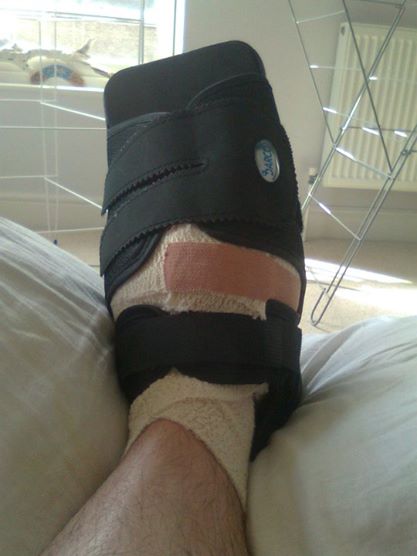
The Tenex procedure can be very short, or in my case it took the doctor 1.5 hours of work on both my feet before she was done. My complete arches on both feet are covered in Fibromas. I was directed to have no weight bearing on my feet for 2 weeks, wore a walking boot for about 4 weeks total, and went through physical therapy afterwards as well. I found doing both feet at one time was easier, because it levels out my walking with the books they gave me.

8) How long ago was the Tenex treatment? Have the lumps grown back? If yes how long did they take to grow back and are they worse now? 

It’s been two years since my last Tenex procedure and the lumps are hard again and big as they were before the procedure, but I expected this to be an ongoing procedure for me. I do recommend the surgery, because it does provide some relief. Some relief is better than no relief to me.

9) What would you say your standard of walking is at the current time and do you think this would be different had you chosen not to have Tenex?

My standard of walking is better, and yes if I’d not had the surgery I’d just be dealing with the big hard lumps, but surgery alone isn’t enough to keep me mobile. My prescriptions also do wonders for my quality of life.

Wednesday, 22 October 2014

Patient series - Patient 1 Introduction

This is the first post on the monthly patient series that I am going to be doing. I have a group of patients that have agreed to answer a set of questions for me every month with the aim of giving a wider overview of patient experiences with this condition. 

Each patient will have an introduction post and the monthly updates will all be delivered together as one post. This is the first introduction post: 

Please note that their first language is not English and I have tried to correct any errors but not changed the content of the post. 

Initial Background Questions:

Please state your age, gender, country of origin and where you live (if different to origin) and how long you have had the condition?

I am a 45 year old male. I was born in the south-west of Holland, where I still live. I have ledderhose from the age of 10

Do you have it in both feet or any hands?

I have it on both feet and hands. I also have knuckle pads. It started on the age of 10, when I stepped into a nail.

Please detail any family history or common risk factors which apply to you:

My father has Dupuytren on one hand. It started when he was 12 when he got a snowball (with a stone in it) on his little finger. His sister also has got Dupuytren. I do not smoke, drink 1 or 2 glasses of alcohol a week and do not have diabetes.

Please list any treatments you have had, the time since you had them, the progress (or lack of) after treatment and any side effects:

  • 1979    First lump under my right foot after stepping in a nail in the middle of the plantar fascia
  • 1979    First removal of a lump under my right foot.The lump was back in three months. Not very painful, was roller-skating after a month.
  • 1985    Second removal of the lump under my right foot. The lump was back in three months.
  • 1995    Third removal of the lump under my right foot. The lump was back in three months. A nerve was damaged during the operation. I had a lot of pain and problems with walking.
  • 1996    Fourth removal of the lump under my right foot. They removed a big part of the fascia plantar and the nerves of two toes. After 6 month of therapy I could walk normal     again without much pain.
  • 2000    There is a small lump under my left foot
  • 2010    My little finger from my right hand is contracting, there are nodules
  • 2010 The lump under my left foot is growing. I have problems with walking. A podiatrist made orthotics for the lump under my left foot.
  • 2011    Partial fasciectomy on my right hand with the use of fire-breaks. Had a lot of edema in my fingers and had to use a pressure glove for several month. During the night I had to sleep with a plastic brace for half a year. The first lump was back after 2-3 months. After 4-5 months my hand was fully operational. I had no pain after using it.
  • 2011 and 2012 I received three injections with corticosteroids in the biggest lump under my left foot. After the first two injections the lump shrank for two to three month. After six month the lump started to grow. After the third injection I had a big bruise under my foot. Walking was very painful. Could only walk on running shoes. I used a special band-aid for under my foot to distribute the pressure. Could not walk far without the band-aid, with band-aid for 30 minutes.
  • 2013   My little finger from my left hand is contracting, there are nodules
  • 2014  Had a needle fasciotomie on my left hand. After 10 days with a cast arm they started with therapy. Recovery was slow. Lump was back in a month. Could use my hand without pain after 5 month. Sometimes still painful. Couldn't sleep with the plastic brace because of the pain.
  • 2014 (June) a nerve in my right hand is giving a tingling feeling. After a day work my hand is beating.
  • 2014 had a fasciectomy on my right hand. After 14 days they removed the stitches and started with hand therapy. Have to sleep with a brace during the night. When my hand is tired during the day I may use the brace for 30 – 90 minutes. Under my left foot I have four lumps. The biggest one is 8 x 5 cm and 1 cm high, the smallest one has the size of a pea.

Please detail any other information from your past which you think may be relevant and not covered in the monthly questions:

The doctor of the Erasmus MC offered to remove the Plantar fascia of my right foot, and use a muscle of my leg to make a new plantar fascia. I think my lumps are to big to use RT, also the health insurance company’s don’t pay for this treatment.

Monthly Questions:

1. In the last month have you noticed any changes in the pain or size of the nodules? Or have any new nodules have developed? 

I feel a nodule in my right hand. The nodule in my left hand is growing. Under my left feet the lumps are growing slowly. I have more pain in my left hand, because I have to use it more after the separation of my right hand. Walking more than 30-45 minutes is painful, can’t stand still for more than 2 hours. On a bad day every step is painful.

2. Please list a) The maximum pain b) the average pain c) the minimum pain you experienced this month and anything that improved or worsened the pain.

On a scale from 0 –10 the maximum pain is 8, minimum is 0-1. The average is 4-5

3. In the last month what medication or treatments have you had, please describe in as much detail as possible including whether prescribed or home treatment, if applicable where the treatment was administered, by whom, cost (if happy to share) and how this has impacted the condition

On the 29th of September the doctor performed a fasciectomy on my right hand in the Erasmus MC, Rotterdam (Holland). I used a mitella for 5 days.  After 14 days they removed 17 stitches and hand therapy was started. I have to practice 5 times a day and received a plastic brace to sleep with. I went to work(office) for half a day 16 days after  the treatment. Pain is getting less. The health insurance company paid for the treatment.

4. Please describe how the condition has impacted you on a daily basis in the last month and any new steps (not treatments) that you have taken to try and alleviate this impact.


I am right handed so the impact is big. Still can’t lift things or unscrew jars with my right hand. Life
is in first gear at the moment.


5. Please describe the level of exercise that you have been able to achieve this month and any specific diets you have used if you think they have impacted the condition.


Went for a walk each day. After 30-45 min walking is painful. Do exercises with balloons with my right hand, the putty is still to difficult/painful.


6. Please list any other information that you think would be useful.

N/A

Sunday, 6 April 2014

Interview with a UK based Dupuytren's and Ledderhose patient

The following interview is with a Dupuytren's and Ledderhose patient from the UK. He has had surgery, more information can be found here. 
1) Do you have Ledderhose disease, Dupuytren’s disease or both?   
photo.JPGBoth. Dupuytren's of my left hand was diagnosed in 2004 at Addenbrooks Hospital, Cambridge. It was causing a lot of pain as it bent up and nodule appeared on the palmar fascia. I didn't really know what it was at first. No surgery was recommended, and it has only slightly deteriorated over the last 10 years. The pain is intermittent, but bad when I catch it on something! I have very limited mobility in my little finger and can’t straighten it. The nodule is clearly visible.
My plantar fibromatosis was diagnosed in early 2009 by Mr Phillip Milsom in Colchester, Essex. He operated on my left foot (the worst of my two feet) in June 2009.

2) Do you have a family history of the disease or have any increased risk from other risk factors such as excessive alcohol consumption, smoking, diabetes etc?
My father had both hands operated on for his Dupytren's at different times; it reduced pain but increased mobility was very short lived. At a family party, I also noticed my great aunt had it in one hand. I don’t excessively consume alcohol, nor smoke. My paternal grandmother was diabetic.
3) How long had you had Ledderhose before considering Surgery? And what other treatments had you received / were you offered by medical professionals?
My GP nearly tried to lance the nodules on my foot! He believed it to be a ganglion cyst, however, thankfully he referred me to the specialist Mr Milsom. This was in early 2009 when I had chronic pain from my foot and it was starting to affect my work and sporting activities. Despite the the risks associated with surgery, he recommended this as the best plan of action. It was unusual to have Ledderhose at my age, I was 26 at the time.
4) Before Surgery were you made aware of the rate of reappearance after traditional surgery and did this concern you?
Yes, but I needed to do something. I am a teacher and I was having to take my shoes off and teach barefoot as the pain was so great. After playing hockey on a Saturday, I had to rest for most of Sunday.
I was warned that that success rate was variable and that they could easily come back, with more or less pain. It was obviously a major concern, but I was willing to try it.
5) Were you at the stage where you couldn't walk before you had surgery / what sort of pain were you in?
Obviously I was not totally incapacitated but the pain was regular and at times severe. When I woke up in the morning, it was often bad. I had a burning sensation or a dull ache. Walking on uneven surfaces was particularly difficult, the beach was the worst! I had to stop wearing several pairs of shoes as they were just impossible to wear without huge amounts of pain.
6) What kind of surgery did you have and how long did it take?  
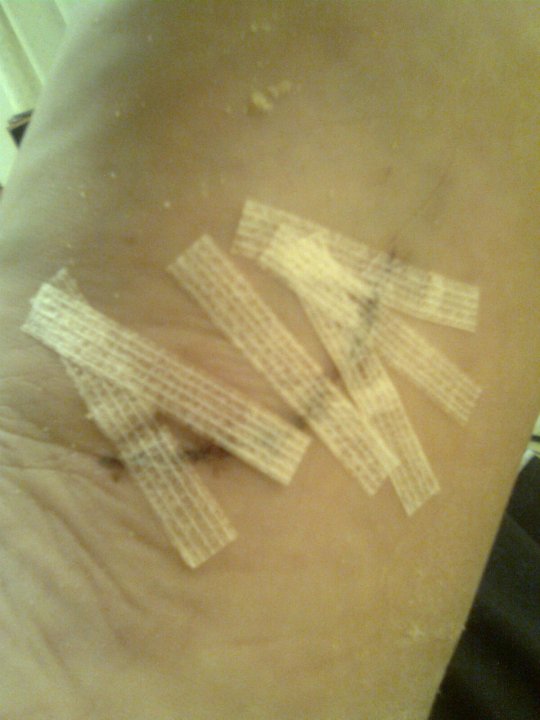
34255_683679309390_4913749_n.jpgA large part of the plantar fascia was removed including the section where the nodules were. This operation was carried out by the consultant himself at Colchester General Hospital, Essex.
I was under local anaesthetic, I had several injections in my foot before being taken into surgery. My foot was elevated and a screen placed across my torso so I couldn't see down to my feet. It was a very odd sensation, it felt like someone was drawing on the base of my foot with a biro pen.
The operation lasted about an hour. After which I was allowed to go home.

7) How did the treatment go? How long did the treatment take and what was recovery time like?
29922_680035461690_6393512_n.jpgThe operation was a success. However the recovery time was long. I had the operation on the 1st June and I was on the sofa for June, July and most of August. I returned to work on the 1st September.
Friends and family were good to me and took me out, however I can see how depression can kick in. I was taking a large dose of painkillers to begin with, but they left me constipated, and so I had to reduce those. I found it impossible to get comfortable and I slept a lot.


8) How long ago was the Surgery treatment? Have the lumps grown back? If yes how long did they take to grow back and are they worse now?
photo.JPG

The surgery was 5 years ago (2009), and the nodules reappeared about 2 years after surgery. I actually now have more and bigger nodules, however they are less painful than before. I regard that as a partial success.
However, as I am only 30 now, I do worry that the pain will return to the level it was previously. I still get the burning pain and the dull aches, and after sport it can be very painful. I elevate it when this occurs.

9) Would you say that the surgery was worth it? And would you recommend it to people that have Ledderhose? Would you consider having it again?
For pain relief, yes it was certainly a success. However I do have reservations about it being labelled a cure. Perhaps it is for some people, but obviously mine are now bigger than they were previously!
Since discovering this blog, I am in the process of considering my next step. I am looking at alternative treatments as I do worry that this is only going to get worse. I love to play hockey, and to run; I have managed two half marathons with my Ledderhose.  
10) What would you say your standard of walking is at the current time and do you think this would be different had you chosen not to have Surgery?
I would definitely say things are better, and perhaps its current state is the best it ever will be. I think I have come to the realisation that this may be something I need to cope with for the remainder of my life. There are worse discomforts in life, and it is certainly not debilitating. It is an inconvenience though, and I do very much worry that it may get worse at some point in the future.
11)  What treatments have you tried since surgery?
None to date.
12)  What treatment options are you considering now?

I plan to visit my GP in the area where I now live and start the process from scratch to see what is offer in my new area (Upminster, Essex) on the NHS. However I realise that I may need to seek private treatment either here or in the US. If something closer to a cure is available, the cost will be insignificant compared to the freedom it would offer.
That is the end of my interview with Andy Lewis. He has given some great answers and it is interesting to hear that at the moment his surgery is sort of successful as he isn't suffering from the same degree of pain as he was before. It will be interesting to know what treatment he is offered and what treatment option he goes for. There are certainly still some available whether it be Radiotherapy, Cryosurgery or an enzyme injection.

Saturday, 25 January 2014

A patient experience of Cryotherapy and Verapamil

About 5 years ago, I developed a bump behind my big toe on my right foot.  I had no idea what is was.  I mentioned it to my doctor, who is a very well connected Dr, in Philadelphia.  (I drive 2 hours to visit him from my home town).  He referred me to Dr. Robert Cohen.

I really had no idea what to expect, and sort of assumed that as long as it was not cancer, it was going to be no big deal.  Well, it was not a cancer, and Dr. Cohen confirmed it.  At this point, I had no real discomfort, but was worried about the bump.

He put me on Verapamil as the initial treatment, and it did not really do anything. 

Dr. Cohen subsequently did a cryosurgery on it, and I really expected it to be broken up and dramatically shrunken after the procedure.  I revisited a few weeks later, and the Dr. was quite happy with the change in size and shape.  I personally really did not notice any significant shrinkage, but it had become a bit elongated.

Over the next 2 years, I did the procedure 2 more times, with nominal results, that were duly noted by Dr. Cohen after he ran an ultrasound each time.

After the 3rd treatment, I stopped going.  I really did not feel any great change, and I had not really had any significant pain anyway. 

I had been given a pair of orthotics to lengthen my arch, with a small shaping around the fibroma to remove some of the impact on it as well.

I went through the next 2 years, with no real concern about the fibroma, and I felt like the cryosurgery was pointless.

I have recently changed my mind.  The fibroma has gotten a little bit larger, and is much more painful.  I get the burning sensation that others describe.  In particular, each morning when I first put weight on it.

I will be going in February to have it evaluated again, and have a new cryosurgery.  I am hoping it will disrupt the fibroma enough to set it back to where it was just an annoying bump without the intermittent pain and burning.

The Cryo process: 

The surgery is really simple.  They numb the foot, cut a small (size of a drinking straw) hole in your foot, and insert a tube that forces cold (like a dry ice) into the fibroma. They continue this insertion until the point where the cold my damage other tissues.  You are wrapped in a sterile bandage, and your foot is wrapped in a hard paper boot, that diverts weight around the arch, and you walk out.

After 3 days, you take the bandage off, and put anti biotic on twice a day like a normal cut, and go about your business.

Cryosurgery is NOT a cure.  Not even close.  It may not even reduce the fibroma.  But, my instincts tell me that it did delay any increase in size, prevented pain within the fibroma, and was a good thing.

I would like to emphasize that my final thought in cryo is that it is a tool to reduce pain, nominally shrink and reshape the fibroma and slow the process down.

Sunday, 15 December 2013

My top moments to get to 100,000 page views

Ok so the crazy moment has arrived where my blog had now had 100,000 page-views!!!!

When I started the blog I never imagined I would get 10,000 page-views let alone to 100,000 and sometimes 5000+ in 1 month. Although I have been the one asking a lot of the questions and doing the research I have to thank everyone that has done an interview as they are really popular and helpful posts that really make the blog as successful as it is. 

When I got to 1000 and 10,000 page views I did a recap on some of my favourite posts and things since I started and I thought it would be nice to do that all again, especially as so much has changed. Not surprisingly none of the science posts or treatment posts will make my list as although they are useful they were not as enjoyable as many other posts. 

1) The original post that I have been updating. This is by far and away the most viewed post on the blog and probably is one the most useful posts. I started this post when I was very low and my foot was really starting to progress and get to me more and more. It began to show to others how I was feeling and how bad the foot was, it ultimately it was started the blog and got the ball rolling. 
Everyone who ran / walked to help raise money for me to get radiotherapy.


2) The run to raise money - Whilst the post was not that significant and may not be that useful to visitors the run itself showed me how much various people cared for me, how much of their time efforts and money they were willing to donate to help me and to get my foot better. Thank you again to everyone who ran and donated as this was the start of road to radiotherapy.


3) I got married - It seems like a long time ago but back in February 2012 I got married to my wonderful wife. She was my rock when this condition was awful and I owe a lot to her. There is no specific post for the wedding but instead I'll link to the interview she did for the blog.


Me and the machine about to zapp me.

4) Starting Radiotherapy with Dr Shaffer - Back in May 2012 I started radiotherapy with Dr Shaffer. This treatment has so far led me to be able to live a normal life, no walking stick and I can run and play badminton. I remember the day my wife and I went for this first day, it filled me with hope and was the first time I had had anyone draw on my feet.


5) My interview with Dr Shaffer - I am not referring to the consultation (which was very good) but to the interview I did for this blog. It was the start of getting specialists to post on here, a great addition and it brings a genuine medical perspective to the treatments. I am biased because Dr Shaffer treated me but he did give a very detailed review of things and I am still in contact with him now.

6) Helping other and their e-mails - By far the best thing to have come out of the blog is that I have managed to help others. It is a fantastic feeling when someone tells me that my blog has helped them, whether it just be that they no longer feel alone or whether it is like the linked e-mail where the lady found Radiotherapy and Dr Shaffer. I have continued to stay in touch with the very nice patient who contacted me and she, like me, has seen a great improvement after radiotherapy.

7) Ditching the stick - Pretty much all of 2012 was spent hobbling around with a walking stick and in a great amount of pain. Towards the end of 2012, after my radiotherapy, I gradually started to walk without the stick and come the end of the year I decided to walk with the stick. It got put away and I no longer carried it with, since then I have not need it and have progressed on to...

8) Playing badminton and running again - When I originally started the blog I did a post along the lines of the things that I miss, when I came back to it later the only thing I really missed was badminton and my freedom to be able to get off the bus a stop early or walk from a car park to a restaurant etc. I am now back fully playing badminton and running (up to) 10km. Anyone who has this condition will know what it feels like to live with it day in day out and to get away from that and being able to run was the ultimate way to celebrate radiotherapy working.

9) Amelia -Just as I was starting to get over this condition my wife became pregnant, this was fantastic news and I remember how delighted I was to see the positive test. However from there the pregnancy was awful, constant sickness and trips to the hospital for dehydration. Still at the end of it our beautiful daughter arrived. Amelia is fantastic and her smile never fails to light up a room. I can wait to see her develop and I am loving seeing all the changes that take place as her personality takes shape.

Some things still annoy like when doctors say they will do an interview and never send back their answers or they just ignore the first e-mail, I am not asking a lot of them and not only could the interview help patients but it also helps patients find them.

I guess the next goal is to get to 1,000,000 page views and more importantly hopefully help at least 9 times as many people in the next 900,000 page views as we have helped in the first 100,000 page views. 

Thank you.