Showing posts with label Plantar Fibroma. Show all posts

Thursday, 4 April 2024

An Update on Me - 12 years post Radiotherapy

I wanted to give a detailed update on me and my Ledderhose and more around my lifestyle in general. 

For new visitors please read the following post to see my background.

In short my journey prior to successful treatment:

  • Noticed lump in foot around 2009.
  • Got sent for physio! And was rightly told that they could not help.
  • Advised to wear supportive running trainers. Note I weighed around 18 stone, so at 5ft 9 this didn't help.
  • 2011 started to become more painful. 
  • Had Steroid injection and it helped for a few months then it came back angry.
  • NHS Foot specialist advised that surgery would likely result in it coming back so not worth it except as a last resort. 
  • I was working towards a PhD in Cancer research so delved into the science and started this blog. 
  • Referred for and fitted with orthotics which helped a little as well as having diagnosis confirmed with an MRI. 
  • Became super painful but told other than surgery, which is a last resort, there was nothing the NHS could do. 
  • I started using a walking stick to get around and take some weight off of my foot. 
  • My wife found radiotherapy with Dr Shaffer as an option. 
  • I was treated in May / July 2012 and combined with moving away from the lab to a desk job I found myself recovering quickly.
  • Throughout 2013 my foot continues to improve to the point where you wouldn't realise I had it. 

The Ledderhose:

So firstly the Ledderhose. In terms of pain I am still in a great place, I have very little if any pain from the Ledderhose disease. I can sometimes feel an ache around where the nodule is when I have been doing a lot of running but nothing prohibitive. Now you will notice that I said where the nodule is... In the last 6 months or so the nodule has grown again. So it was very small and dormant for the best part of 9-10 years and in this last year it has grown a little. It might even be bigger than it was before however, even with my running, it is not causing pain above 1/10 let alone the 9/10 I was getting on every step before.

In terms of my journey since the start of 2015 I collected a whole bunch of patient data and presented the results at the Dupuytren's Symposium in 2015. That was a great experience, I got to meet so many specialists and live blogged about the conditions (which was surprisingly popular!). 

My Diet:

Something that can be very divisive but I am convinced that a proper human diet is high meat, low carb and that this isn't even bad for the environment or the animals. This might sound crazy but I, and many others, have done the research and there is just so much money in food and keeping people sick that it is had to impossible for the required research to disprove it to take place. You air these views and are seen, at best as being eccentric and at worst as a conspiracy theorist. Speaking from my own experience, and from many others I have spoken to, the lower in carbs and plant matter people go the better they feel. There is a transition period and a mindset adjustment but it just works. 

Now it might seem odd to mention this on a blog about a foot condition? Well I just wish I knew what I knew now back then. If I had weighed 10 stone (which I do), rather than topping the scales at 20 stone(which I did), had I known how great carnivore (zero carb) can be for auto-immune and its anti-inflammatory effect, could I have saved myself the cost and impact of the radiation therapy and years of stress? My gut tells me probably not but my brain and the results I have had suggest that it would have made everything much smoother, more effective and honestly I do wonder if I had been low carb my whole life if I would have even developed the condition. 

I say that because of the massive impact that reducing carbs has had on my physical health and that of my wife. I think it is shocking that we are being pushed more and more onto a plant based diet and despite these shifts the world continues to get less and less healthy. Anyway I won't say anything more on this other than to say to get in touch if you have any questions. 

Exercise:

Obviously back when this condition was bad I could barely walk and my physical activity was massively hampered. Looking back I wish I had done some weight training or something but motivation was severely lacking. Now I am one of the fittest people I know. I do a lot of weight training and am comfortably able to do pull ups etc. and I am one of the the best local runners, normally finishing in the top 3 at my local parkrun. In fact out of the 15,000+ people that have done the parkrun I am in the top 75 of all time. I try to focus on the process and mental health as well and last year ran 2750 miles, many with my daughter on her scooter, with my wife or with the dog. Since my treatment all those years ago I even (badly) completed a marathon for the British Dupuytren's society and still proudly wear my BDS running vests now. 

The Treatments:

Honestly not a huge amount has changed. I would love to be able to say there have been advances and there are some great new injections but the treatment landscape looks much the same now as it did back in 2012. Hard to believe that it has been 12 years.

Finally...

I am now hitting the 12 year anniversary of starting radiotherapy with Dr Shaffer. Having that radiotherapy was one of the best decisions of my life and something I am so grateful for every time I step out the door for a walk or a run. Honestly I am concerned by the growth I have seen over the last 6 months but also optimistic as the lack of pain I am suffering. 

In the future I am hoping to keep on running, getting quicker and pushing through what I ever imagined possible 12 years ago. Hopefully it provides some inspiration and hope to other patients and I continue to keep an eye on research in the hopes that better treatments come along. If I get the time I will try and do a review of some of the literature but accessing and understanding it is much harder now that I am not longer in science. 

Happy feet everyone and please get in touch if you have any questions. 

Monday, 2 August 2021

Collagenase for Ledderhose?

I have previously covered the topic of Collagenase injections by looking at various aspects of it including its use in cells, interviewing a Doctor that uses it for Dupuytren's and covering the material presented at the Dupuytren's symposium. Because it has not been approved for Ledderhose I don't have a specific page in detail on the treatments page. 

There are a couple of different enzymes that have been trialled to break down these lumps and it looks like Endo are hoping that their product can be an option for Ledderhose. 

Endo Presents New Investigational Collagenase Clostridium Histolyticum Data at the American Podiatric Medical Association Annual Scientific Meeting


So what does the article actually say? 

That there have been some encouraging clinical trials done on using CCH in the treatment of Ledderhose disease. Basically so far their studies are indicating that the injections are well tolerated by the majority of patients and that most are seeing an improvement in the condition. Overall it sounds promising but obviously they are still looking into it and I know there have been mixed experiences with using it to treat Dupuytren's. 

Would be good to have another treatment for Ledderhose, of course assuming that is a successful and viable soltiion. 

Saturday, 20 July 2019

Little Update - 7 years post RT

Hmm, well it seems that it has been 7 years since I finished radiotherapy on my left Ledderhose foot. Those that have read the blog will know that it has been quite a transformation since then and as a result I haven't had much to post about. However I am still getting quite a few enquiries and wanted to let these people know that I am still monitoring the blog and the associated e-mail account. 

In 2019, after a knee injury in 2018, I am back to running and am even in some "barefoot" shoes as I find they help my knee. My foot is still fine and I even came 3rd in a race earlier in the year. Sure it was a low-key race but still not a bad thing. 

As always if you have any questions get in touch, if you want to contribute with an interview as a doctor or a patient... get in touch or if you are aware of some research that I might like to see (and try and remember my science degree!!!) then get in touch :-) 

To be honest I don't really have much to say and this was really because I had feedback that a post would be appreciated by some of the readers :-) Here is a picture of me running 


Tuesday, 21 July 2015

3 years post radiotherapy, what a difference

So it has now been 3 years since I finished radiotherapy (well yesterday was) and thing have improved even more since last year. 


I don't think that the improvements since last year have been a direct result of radiotherapy but rather because I can exercise since having had radiotherapy. This year we decided to get fit and lose weight, we have decided to do this using a low-carb diet. 

There were many reasons that we picked this diet and I have actually since found several papers suggesting that the decrease in sugar is good for reducing tumour growth as they can be highly reliant on sugar as their primary energy source. 

And pretty much since starting the diet the residual pain in my foot, for example after exercise, diminished and has now gone. It is great that I hardly have to actually consider my foot any more. The only time that I notice it now is when I step on something without my trainers on. 

The lifestyle change has gone really well and I have lost a significant amount of weight and my dreams of one day running a marathon are back on, who would have thought that 3 years ago! 

Left: Wedding July 2015, Right Wedding August 2014
This year has also been eventful because of the amazing trip to Groningen. The conference was amazing and I learnt a lot. Thank you to everyone for the support again and as usual if there is anything you want to know then please ask and I will do my best to cover it. 

Thursday, 29 January 2015

Plantar Fibroma and marathon running

Today I came across a story, the story was not primarily about Ledderhose but about a brother becoming a marathon runner after his brother died of one whilst running one himself. However the article mentions that the person in question had to have an operation for a fibroma on his plantar fascia. This keen runner still then goes on to run a marathon and then runs it in 2 hours and 20 minutes which is an amazing time for anyone let along someone who has had a plantar fibroma operated on. 


Now whilst I am not planning on running a marathon, at least not any time soon, I am hoping to beat both my 5 and 10k personal bests this year and work towards training for a 10 mile race next year. I know that my body is coping well with running and it is helping my weight to come down.

It would be great to hear from anyone else that has had any treatment (or none) and gone on to do running. I think from my experience the best advice I could give is to make sure you get proper running trainers and make sure they are the right type for you. I need the ones with the extra support on the outside from where I had been putting all my weight on the outside of my foot.


Thursday, 23 October 2014

Patient series - Patient 2 Introduction

Today I have an introduction to the second patient on my patient series. 

Initial Background Questions:

Please state your age, gender, country of origin and where you live (if different to origin) and how long you have had the condition?

I'm 54 years old, a female, and from Toronto, Ontario, Canada.  My mother's father was from Scotland.  I noticed a bump on one foot about 5 months ago and they have only started to grow and become painful in the last three weeks.  I did a half marathon on September 29th and my feet were very sensitive after that race which was new for me.

Do you have it in both feet or any hands?

I have it in both feet.  I had an ultra sound done and I currently have one medium sized one on my left foot and three small ones on my left foot.  They are currently growing and are mildly painful when sitting. 

Please detail any family history or common risk factors which apply to you:

My mother has Dupuytren's Disease in both hands as did her sister and her mother.

Please list any treatments you have had, the time since you had them, the progress (or lack of) after treatment and any side effects:

I've only had an ultra sound done so far but I'm seeing a Podiatrist on November 18th who I know has ordered Transdermal Verapamil 15% gel for two of his other clients.  I'll find out from him if the other two clients have had any success with it to decide if I should try it as well.  Because they're mildly painful when sitting I'm worried they will progress from there so I will be looking to have Radio Therapy done and am investigating whether Canada actually has someone that does it or not.

Please detail any other information from your past which you think may be relevant and not covered in the monthly questions:

N/A

Monthly Questions:

1.   In the last month have you noticed any changes in the pain or size of the nodules? Or have any new nodules have developed? 
I started out with one nodule on my right foot and now have three which have grown in the last three weeks.  The one on my left foot has been growing as well.

2.   Please list a) The maximum pain b) the average pain c) the minimum pain you experienced this month and anything that improved or worsened the pain.
I'm still at the minimum pain stage and have only been using Advil to control it.

3.   In the last month what medication or treatments have you had, please describe in as much detail as possible including whether prescribed or home treatment, if applicable where the treatment was administered, by whom, cost (if happy to share) and how this has impacted the condition. 
Nothing at this point but hope to start something.

4.   Please describe how the condition has impacted you on a daily basis in the last month and any new steps (not treatments) that you have taken to try and alleviate this impact.
I was a co-founder of a walking group where we train 3 times a week so this has very much impacted my life.  Aside from staying off my feet there isn't anything else I can do at this point. 

5.   Please describe the level of exercise that you have been able to achieve this month and any specific diets you have used if you think they have impacted the condition. 
I've been doing Plantar Fasciitis exercises and they seem to be help.  I'm also working with my training to find exercises I can do that won't bother my feet.  I plan on starting to swim.

6.   Please list any other information that you think would be useful. 
 Sorry I don't have any at this point.
https://ssl.gstatic.com/ui/v1/icons/mail/images/cleardot.gif


Sunday, 21 September 2014

Shockwaves for Dupuytren's, Ledderhose and related conditions

Recently I came into contact with a gentleman at Cell Sonic, they manufacture the equipment used to treat with Shock-Waves. This is an interesting treatment which has very little documented evidence. My gut says that this is a treatment that is worth a try. From what I have read it appears that there is very little to lose in terms of side effects or aggravating the condition but it could potentially help. Really what is need is a bigger and better study than the one I discussed before

Anyway the guy that I spoke to is extremely passionate about this technology and it was clear to me that he really thought that it could be a great way to treat many different problems. 

Below is a copy of some information that I received from CellSonic and have published with their full permission. If there are any doctors that are interested in using this treatment then please get in touch. I have been told it is a diverse piece of equipment and that it would pay for itself without even taking into account the conditions I am interested in. Then again the person selling it is of course going to say that. 

Doing a bit of research and a quick search of PubMed certainly shows that there is a lot of information out there and it has been used to treat scar tissue and many other conditions. 


Dupuytren's contracture can be almost totally cured using CellSonic’s electro-hydraulic shockwaves. This is a non-invasive, drug free treatment that takes about five minutes. Sudden bursts of sound are directed into the palm and fingers to loosen the tightening cells pulling the fingers. The vital characteristic of a shockwave is that from zero decibels to high must happen in a few nanoseconds. To achieve that, CellSonic flashes 25,000 volts across a one millimeter gap inside water and the sound wave projected through gel into the hand which is also acting as water. The fast moving sound wave hits the tightened cord and stretches it. Moreover, it activates stem cells to migrate to the site because through the nerves the brain has detected a problem and is  instructing white blood cells to make a repair. The patient will feel the shockwaves and it will be uncomfortable, some would say painful, but do tolerate it because the nerves are sending a necessary message to the brain. An anesthetic would block that message and the immune system will not be activated. The fastest rise time of decibels is achieved with the CellSonic machine so fewer shocks and fewer treatments are needed. The recommendation is for 1,000 shocks at energy level 5 using a shock head focused at 5 mm. Aim the shocks on the area of the palm and the fingers where the tightening is apparent, keeping the shock head sliding gently around on the gel. If another treatment will help, do it two weeks after the first. Improvements are still taking place a year after the last treatment. This is because the shockwaves are causing new cells to grow thanks to the stem cells. Dupuytren's contracture involves similar cell damage to that experienced with plantar fasciitis, Ledderhose Disease and Peyronie’s disease. They can all be treated with the same protocol described above except Peyronies needs fewer shocks at lower energy level.

There are no side effects and that has been proved over the last 40 years because the same technology has been used with much more powerful machines to break kidney stones and millions of patients have been treated without side effects. Other applications with shockwaves include healing wounds because they kill infection, repairing broken bone, treating sports injuries and releasing pain. In Germany, CellSonic shockwaves are being used to reduce cellulite and this will soon be marketed in other countries.

The shockwaves will do two things. Firstly they will damage, soften, loosen and release the tightening tendons and cells which are causing pain and problems. This is an alternative to the scalpel which certainly has side effects.

Secondly, the immune system is triggered because the brain senses that the body has been attacked. It is the immune system that causes new cells to grow and that is achieved by causing stem cells to be released by the pelvic bone where they are stored. It has been shown that zapping the pelvic bone is helpful.

The distributor who can arrange for doctors to try the machine is:
Mark Wilson, Managing Director
Cellsonic Ltd
M            07794822295
E              mark@cellsonic-medical.com
W            www.cellsonic-medical.com
T              @cellsonicESWT

Saturday, 13 September 2014

Interview with Dr Bocian, Laser treatment for Ledderhose

Today I have an interview with a Dr who does Laser treatment. I actually only asked for this interview after a patient e-mailed me asking if I had heard of it. I have heard of it but I have not seen any evidence for it or any information in the public domain and thought it was worth trying to do something about that. 

The person I contacted was Darin whose website can be found here. Darin has been very helpful and has been very happy to answer my questions and has kindly asked a patient if they would contact me. They did contact me and I have an interview with them as well. So please keep reading to find out a but about Laser therapy for Plantar Fibromatosis. 

1) Do you often come across plantar fibroma’s? How common would you say they are in the USA?

It is relatively uncommon; I see about 5-10 cases per year. Some of them are small and may be asymptomatic.
  
2)  Do you seen any common risk factors in patients?

Although in the literature there are risk factors associated with plantar fibromas, due to the limited amount I see,  I have not been able to drawn any conclusions.

3) I understand that every case is different but what course of treatment do you recommend for early stage Ledderhose?

If lesion(s) are asymptomatic, no treatment, simply monitor for changes.

If painful, I have found cortisone injections are not very helpful; if any improvement achieved, it is temporary. An accommodative shoe insert may help.

I recommend transdermal verapamil gel 15% with Nd:YAG laser treatment. I have found verapamil alone provides extremely slow and limited improvement. However, the gel combined with the laser seems to work synergistically. Using the laser and topical gel together, seems to enhance the reduction of symptoms and reduces the time it takes to reach this goal. I have also seen a reduction of the size of the nodules following the treatment. This is most notable in the smaller lesions.

4) I see on your website that you perform laser treatment, what is this and how does it help with plantar fibroma’s? What sort of success rate does it have and can it be repeated?

The exact mechanism of how the Nd:YAG pulsed laser works for plantar fibromas is still uncertain. In fact, the mechanisms of interaction between laser and tissues in general is not well understood. It is FDA cleared here in the USA for scar tissue.

According to the limited research available, it seems to have an effect in the inflammatory process and in the formation of functional tissue. It is suggested in the literature that the ” Nd:YAG pulsed laser can efficaciously promote tissue repair process”. Much research is needed in the biomedical effects of laser.

5) What is the procedure and recovery times for laser treatment?

The procedure involves weekly in office laser treatments. Topical transdermal 15% verapamil gel is applied to the lesion and allowed to be absorbed for several minutes.

The laser treatment is performed without anesthesia. There is mild discomfort as the absorption of the light to the area will generate heat. Stopping the treatment for a few seconds alleviates the discomfort and then laser treatment is immediately restarted. Between these short interruptions of treatment, the lesions is gently massaged. It is necessary to undergo several treatments depending on the size of the lesion. Number of treatments can range from 10 to 20. There is no down time following treatment. Patients continue activity as tolerated. The entire treatment time ranges between 5-10 minutes.

6) You also recommend Verapamil with Laser treatment, what are your thoughts on verapamil as a stand alone treatment? 

Verapamil gel alone in my experience provides only minimal improvement even after several months of treatment.

7) Why do you think that a combination of the 2 treatments work? 

I believe the key to my successful treatment of plantar fibromas is the combination of the laser and the gel.

8) Do you have any other advice that you would like to give to patients with this condition?

Surgical excision in my experience should be avoided if possible. I have surgically removed many plantar fibromas. The success rate is not very good. The complications following the procedure can include hypertrophied scar tissue, adhesions and of course reoccurrence. Unfortunately, the undesirable outcomes following the procedure can make both the doctor and patient wonder if the surgery was successful.


Darin Alan Bocian, DPM, FACFAS
1845 W. Orange Grove Road, Suite 125
Tucson, Arizona, USA  85704

Monday, 8 September 2014

Ledderhose patient treated with RFA and blood platelet injections

Today I have an interview with a patient from the USA, I came into contact with her through one of the many different forums / groups and she has had some treatments that sounded interesting. She was kind enough to answer my questions and provide a few pictures of before and after pictures. 

1) Where are you from?

I reside in North Dakota and part time California.

2) Do you have Ledderhose and/or Dupuytren's? 

Ledderhose

3) Do you have a family history of this condition? 

Unknown, my Dad had 16 brothers and sisters many I did not know.

4) How did you find the medical awareness of these conditions? 

I first noticed a lump but was very busy at the time, before I knew it it felt like I was walking on a golf ball. I went to Dr. Sabot at Mission hospital in Laguna Beach ca. He told me I had a plantar fibroma and by now I had a small one coming on the other foot also. But the one on my right foot was two large masses.

5) What treatment options were you offered?

Radio frequency ablation. I also had a bunion fixed on one foot which was the difficult part. The ablation was pretty much painless after and I definitely noticed a reduced and soften in both fibromas. I needed to return to the operating room to have the screw out which I was allergic too, he recommended the area of my large fibroma be treated again with blood platelet injection to decrease and soften it even more. 

6) What condition were you in when you were looking to get treatment? (Pain wise) 

I was about 7 out of 10 sometimes worse than others.

7) What is RFA? Please could you describe the treatment process you underwent with RFA and blood platelet injections? 

The definition for radio frequency ablation is as follows. Radiofrequency ablation involves the use of heat to destroy fibroid tissue. It is a laparoscopic procedure involving small incisions.

Ultrasound is used enabling the surgeon to see the fibroids clearly.

A long needle-like device is then inserted into a fibroid. When it is in the middle of the fibroid, heat is delivered until the entire fibroid is destroyed. The process is repeated until all of the fibroids have been ablated.

Each treated fibroid will shrink in size by about 40 percent within three months of treatment.

8) How successful would you say the treatment has been? 

3 years post op and I feel I had good results. However, Now I have a new one coming on the foot that had the large fibroma but it is going off to the side. He feels I should do Tenex on it. I am not convinced and I am doing research and getting more opinions. I think it was pretty successful  however and the blood platelet injections did push it along to soften more. 

9) What other treatment options are you looking into now and what are your thoughts on them? 

I have not found anything my insurance will cover. I am therefore considering paying out of pocket for something. I am not sure what however, nothing gets my hopes up. I am getting more opinions in California as North Dakota DRs just want to cut!

I am an aesthetician and have some pretty cool equipment so I have decided to use some of it on my fibroma and see what results I can get. Currently I am using cold hammer therapy with blue light. It really helps reduce inflammation and is soothing. I'm going to do it 3 times a day for 60 days and see if I notice anything.


Before rfa blood platelet injections:


After three years, now you can see one coming off to the side.

Wednesday, 3 September 2014

Interview with DD and LD patient treated with Tissue Plasminogen Activators for LD

Today I have an interview with a patient from Australia. This patient has had an injection of tissue plasminogen activators from Dr Chin. The results for this patient are very good and I am lucky enough to have a very comprehensive interview with this patient. 

1. Do you suffer from Ledderhose and or Dupuytren's?

Both  - in both feet and both hands

2. Do you have a family history of the conditions? Or fall under any of the risk factors? 

Ex-smoker from age 12 stopped at age 40 moderate alcohol, hit it hard like most teenagers when in the British Army, Mum had DD, no one else in family seems to have it, 4 siblings and to the best of my knowledge no immediate family (Nephews/Nieces/Cousins) show any signs

3. Where are you based, how old are you and how long have you been suffering with the condition and how has it developed over time?

Now living in Redcliffe, north of Brisbane in Queensland Australia.  Aged 60 and 7 months.  First recollection I had DD which appeared first on my left hand was around 20 years ago followed shortly by LH on my feet.

The left hand and feet started first followed shortly by the right hand and foot.

4. What treatment options have you had?

Left Hand

5 Needle Aponeurotomy 3 in USA with Dr Eaton and two releases locally in Australia.

1 partial strip to release the very badly swollen ring finger knuckle, which has kept the finger straight for 10 months now, but some nerve damage.

Right Hand

3 Needle Aponeurotomy in USA with Dr Eaton  The ring finger on the Right hand is starting to get to about 15 degrees but it is also twisted and the knuckle is swelling so may look to a release soon.

Left Foot

Tissue Plasminogen Activators injection at the same time as my left hand was operated on (under General anaesthetic).

5. You have been treated with Tissue Plasminogen Activators, could you please explain how you found out about this treatment and why you picked it over other treatment options?

I was informed of Dr. Chin from a contact I met at a meeting and followed up.  The Colleague was very enthusiastic about it as he was a Biotechnology Consultant who was working with Dr. Chin and had seen the results.

I was privy to some commercially sensitive information regarding the treatment and its efficacy and the path Dr. Chin was taking and decided it was safe enough to try particularly as it is below any dose given for other clinical reasons for which it is approved.

I have studied the results of other treatments and apart from some success with RT could not see anything that was successful.  I did attend an RT clinic here in Brisbane but was not convinced they had the experience at that point.

Dr. Chin has treated in excess of 100 patients for Ledderhose and I am unsure how many for DD.  He has stated that for Ledderhose after 10 years plus there has been no recurrence, but for DD recurrence has occurred in some patients after 5 years.

There are no significant side effects that have been reported, there is a very small chance of temporary impotence.

6. Please describe, in as much details as possible, the procedure to administer the treatment and the recovery period?

The injections were made into each nodule in the foot, (I think he missed one).  For me it was under anaesthetic as I was having the DD treated, but normally done with a local anaesthetic.

Pretty sore for two days, walking on the outside of the foot.

The foot settled after 3 days then the nodules started to immediately shrink.  Massaging was indicated for helping the TPA work in the nodule.

I was warned the top of the foot would hurt after 3 - 5 weeks, Dr Chin said this is because the foot will flatten and muscles and tendons would be stretched that had been contracted and sure after about 4 weeks that is what happened.  The pain lasted about a week and since then has not been a problem.

7. How has your condition progressed since you had the treatment and are you happy with it?

Some 10 months later there is one very small nodule on the left foot that has been there since the injection (I think this is the one he missed).  Cramping has greatly reduced in my left leg!  There is no sign of the original nodules so I would call this treatment a success.  I will be going to Dr Chin possibly early in 2104 to get my right foot treated.

8. Is there any more information you would like to share with the patient community?

My experience is a positive one, perhaps I have been lucky but TPA is striking at the very core of the tissue mass and has been utilised for heart attack victims for many years to break up clots.  Dr. Chin is attempting to license the treatment to recover the cost of his research to date, I hope he gets a sponsor and makes this treatment more available.  Some of the photos he showed me of before and after have been spectacular so I feel it is a worthwhile treatment to pursue.


It certainly is a very interesting treatment option and not one that I am aware of being used anywhere other than by Dr Chin (probably because he has a patent). Hopefully there will be a publication soon that show all the results, if they truly are 100% for Ledderhose then that is really very remarkable and perhaps this option can become more mainstream in the future. 

Monday, 1 September 2014

Australian Ledderhose surgery patient

Today I have another patient interview. This was sitting in my IDS forum inbox for a month without me realising. It is with a surgery patient from Australia. 

Where are you from? 

Adelaide, Australia

Do you have Ledderhose and Dupuytren's? 

Yes, I have Both conditions and have had so for approx. 8 years

Do you have a family history of this condition?

 None that I am aware of.

How did you find the medical awareness of these conditions? 

I was misdiagnosed for approx. 4 years as having Ganglion's and it was only by sheer luck that my new GP had heard of Ledderhose from a fellow practitioner a week before I presented myself to him

You had surgery, were you made aware of the risks of having this? 

I was told "As with any surgery there are risks". But it was never explained what those risks might be.

What condition were you in when you had the surgery? 

At the time of my initial surgery I was what I believe to be as Stage 4. Some days I could barely place any weight on my feet and I would often wake in the night screaming as my feet contracted on themselves.

Could you please describe the surgery process and recovery? 

I underwent the Ankle Block procedure and an S shape incision was made, then as much of the Mass was removed as possible. I was then instructed to stay off my feet and keep them elevated for at least 4 weeks.

How successful would you say the surgery has been? 

Completely unsuccessful, the Mass had already begun to return within the 4 week period of elevation immediately following the surgery.

What other treatment options are you looking into? 

At the moment I am awaiting an appointment with an Oncologist to discuss Radiotherapy. It disgusts me that this was not the first option given to me. I don't believe that because the condition was largely prevalent in my feet that an Orthopaedic Surgeon was the right option. Based on the information on this site a Specialist with this condition should have been the first step, so that I could then be advised of all treatment options.

For example, while I was in the later stages of Ledderhose and surgery may well have been my only option it should have been part of my treatment regime to have undergone Radiotherapy immediately after surgery.


It is interesting to hear of this patients experience, especially with regards to the lack of information they were provided with before undergoing surgery. As this patient said there is no reason why other options (such as radiotherapy) could not be offered before surgery was attempted. 

Thursday, 24 July 2014

Interview: Ledderhose surgery patient from Ohio

Today I have a patient interview with a Surgery patient from the States. 

1) Where are you from? 

I am from Ohio USA

2) Do you have Ledderhose and Dupuytren's?, How long have you had them? 

I am a 49 year old woman and I have both Ledderhose and Dupuytren's. I have Ledderhose on both feet. I have had Ledderhose since I was an infant. My Mother first noticed the nodule on my left foot when I was less than a year old. She doesn't remember more specifically how old I was. So in answer to the question I have had Ledderhose for 48 years. It wasn't until much later that I noticed the nodule on the right foot. I have only had that one for about 8 years. I have only had Dupuytren's for about 6 years.

3) Do you have a family history of this condition? 

As far as I can find I have Absolutely NO family history.

4) How did you find the medical awareness of these conditions? 

Most of what I know about both conditions I have learned on the internet. The surgeon that removed the first nodule is the one that told me what it was called. I didn't get much information from him but I was only 16 and don't really remember much detail from the experience.

5) You had surgery, were you made aware of the risks of having this?

Yes, I have had surgery twice on the left foot. I was only told that it could come back. I was not told much else.

6) What condition were you in when you had the surgery? 

Looking back, I wasn't in bad condition at all. Knowing what I know now I would not have had the surgery then. The condition was stabilized and it had not grown for years. I was involved in things in high school that was most likely putting more stress on the foot and causing it to hurt more. 

7) Could you please describe the surgery process and recovery? 

The first time I had surgery (both surgeries were on the left foot) the incision was only about an inch long (twice the length of the nodule) and went across the width of the foot. They only removed the nodule and the surgery only took about 40 minutes. The time on crutches after the surgery was about 2 weeks. The second surgery was was about 5 years later and the foot had become very painful. Mostly because of the scar tissue from the first surgery but I also had a new nodule. The incision for that surgery was lengthwise of the foot and was approximately 5 inches in length and slightly curved in an "S" shape. They removed the new nodule that was about the same size as the first one. They also removed scar tissue about 1 1/2 x 1 x 1/4 inches. The surgery took about 70 minutes and had the same recovery period of 2 weeks on crutches.

8) How successful would you say the surgery has been? 

I am convinced that the first surgery only made things worse. I am also glad I had the second because I am sure if the nodule grew much more I would not have been able to be on my feet much at all. The second surgery didn't result in the large scar tissue formation like the first. Although in the 26 years since the second surgery I have another nodule and it is twice the size of the ones removed. 

9) What other treatment options are you looking into?

I am very interested in the Radiotherapy that has been discussed. I would like to know more about it and where it is offered in the United States. 

9) Is there anything else you would like to share with the patient community?


Picture on the left is the left foot. This is the one I have had two surgeries on. This nodule is about  26 years old. Picture on the right is the right foot. No surgeries. Nodule is about 8 years old.


Picture on the left is left hand. Not as noticeable since the nodules aren't as large as the foot but you can see that I have a pit of some sort. 

The picture on the right is also the left hand but the hand is turned sideways so you can see a bit more of how large the area is. The first nodule in the hand was noticed 5 years ago. Thankfully the right hand seems to be free of any nodules at this time.


Sunday, 6 April 2014

Interview with a UK based Dupuytren's and Ledderhose patient

The following interview is with a Dupuytren's and Ledderhose patient from the UK. He has had surgery, more information can be found here. 
1) Do you have Ledderhose disease, Dupuytren’s disease or both?   
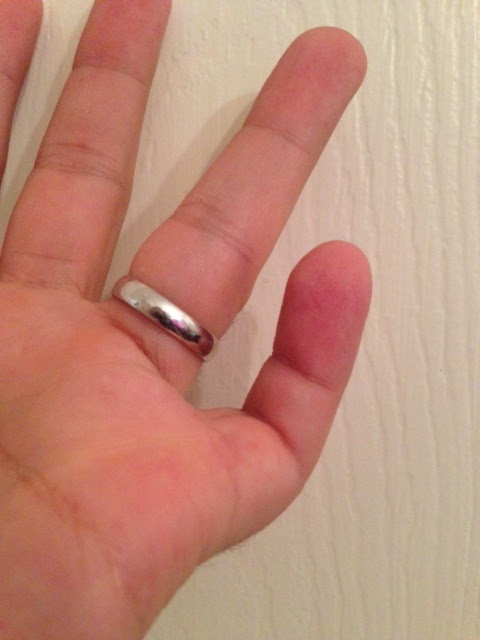
photo.JPGBoth. Dupuytren's of my left hand was diagnosed in 2004 at Addenbrooks Hospital, Cambridge. It was causing a lot of pain as it bent up and nodule appeared on the palmar fascia. I didn't really know what it was at first. No surgery was recommended, and it has only slightly deteriorated over the last 10 years. The pain is intermittent, but bad when I catch it on something! I have very limited mobility in my little finger and can’t straighten it. The nodule is clearly visible.
My plantar fibromatosis was diagnosed in early 2009 by Mr Phillip Milsom in Colchester, Essex. He operated on my left foot (the worst of my two feet) in June 2009.

2) Do you have a family history of the disease or have any increased risk from other risk factors such as excessive alcohol consumption, smoking, diabetes etc?
My father had both hands operated on for his Dupytren's at different times; it reduced pain but increased mobility was very short lived. At a family party, I also noticed my great aunt had it in one hand. I don’t excessively consume alcohol, nor smoke. My paternal grandmother was diabetic.
3) How long had you had Ledderhose before considering Surgery? And what other treatments had you received / were you offered by medical professionals?
My GP nearly tried to lance the nodules on my foot! He believed it to be a ganglion cyst, however, thankfully he referred me to the specialist Mr Milsom. This was in early 2009 when I had chronic pain from my foot and it was starting to affect my work and sporting activities. Despite the the risks associated with surgery, he recommended this as the best plan of action. It was unusual to have Ledderhose at my age, I was 26 at the time.
4) Before Surgery were you made aware of the rate of reappearance after traditional surgery and did this concern you?
Yes, but I needed to do something. I am a teacher and I was having to take my shoes off and teach barefoot as the pain was so great. After playing hockey on a Saturday, I had to rest for most of Sunday.
I was warned that that success rate was variable and that they could easily come back, with more or less pain. It was obviously a major concern, but I was willing to try it.
5) Were you at the stage where you couldn't walk before you had surgery / what sort of pain were you in?
Obviously I was not totally incapacitated but the pain was regular and at times severe. When I woke up in the morning, it was often bad. I had a burning sensation or a dull ache. Walking on uneven surfaces was particularly difficult, the beach was the worst! I had to stop wearing several pairs of shoes as they were just impossible to wear without huge amounts of pain.
6) What kind of surgery did you have and how long did it take?  
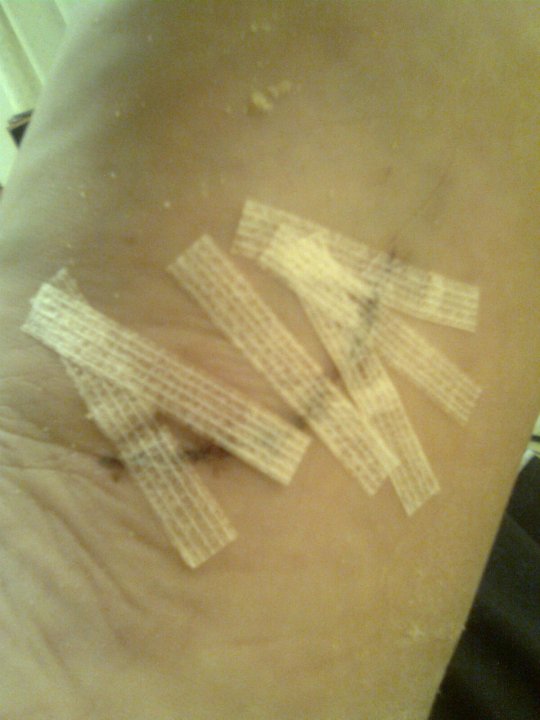
34255_683679309390_4913749_n.jpgA large part of the plantar fascia was removed including the section where the nodules were. This operation was carried out by the consultant himself at Colchester General Hospital, Essex.
I was under local anaesthetic, I had several injections in my foot before being taken into surgery. My foot was elevated and a screen placed across my torso so I couldn't see down to my feet. It was a very odd sensation, it felt like someone was drawing on the base of my foot with a biro pen.
The operation lasted about an hour. After which I was allowed to go home.

7) How did the treatment go? How long did the treatment take and what was recovery time like?
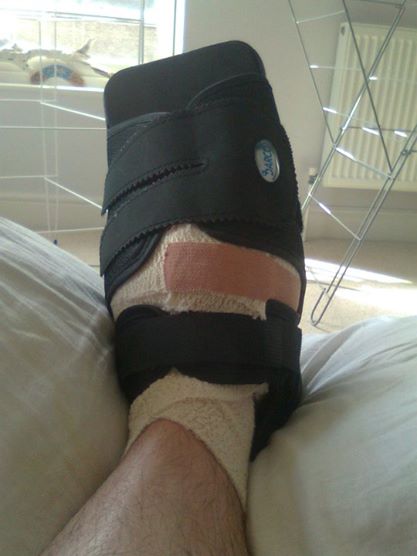
29922_680035461690_6393512_n.jpgThe operation was a success. However the recovery time was long. I had the operation on the 1st June and I was on the sofa for June, July and most of August. I returned to work on the 1st September.
Friends and family were good to me and took me out, however I can see how depression can kick in. I was taking a large dose of painkillers to begin with, but they left me constipated, and so I had to reduce those. I found it impossible to get comfortable and I slept a lot.


8) How long ago was the Surgery treatment? Have the lumps grown back? If yes how long did they take to grow back and are they worse now?
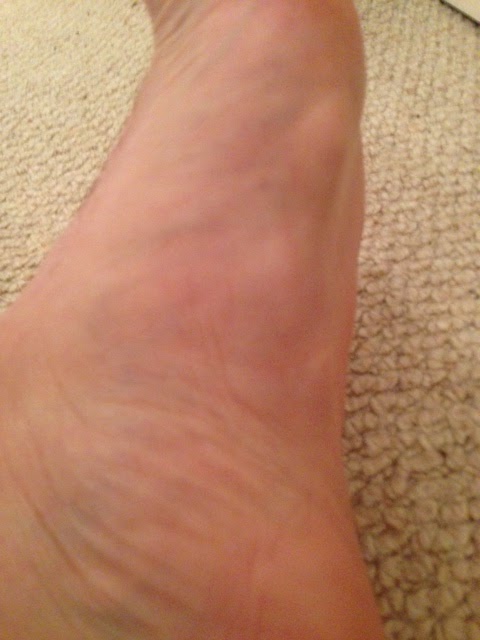
photo.JPG

The surgery was 5 years ago (2009), and the nodules reappeared about 2 years after surgery. I actually now have more and bigger nodules, however they are less painful than before. I regard that as a partial success.
However, as I am only 30 now, I do worry that the pain will return to the level it was previously. I still get the burning pain and the dull aches, and after sport it can be very painful. I elevate it when this occurs.

9) Would you say that the surgery was worth it? And would you recommend it to people that have Ledderhose? Would you consider having it again?
For pain relief, yes it was certainly a success. However I do have reservations about it being labelled a cure. Perhaps it is for some people, but obviously mine are now bigger than they were previously!
Since discovering this blog, I am in the process of considering my next step. I am looking at alternative treatments as I do worry that this is only going to get worse. I love to play hockey, and to run; I have managed two half marathons with my Ledderhose.  
10) What would you say your standard of walking is at the current time and do you think this would be different had you chosen not to have Surgery?
I would definitely say things are better, and perhaps its current state is the best it ever will be. I think I have come to the realisation that this may be something I need to cope with for the remainder of my life. There are worse discomforts in life, and it is certainly not debilitating. It is an inconvenience though, and I do very much worry that it may get worse at some point in the future.
11)  What treatments have you tried since surgery?
None to date.
12)  What treatment options are you considering now?

I plan to visit my GP in the area where I now live and start the process from scratch to see what is offer in my new area (Upminster, Essex) on the NHS. However I realise that I may need to seek private treatment either here or in the US. If something closer to a cure is available, the cost will be insignificant compared to the freedom it would offer.
That is the end of my interview with Andy Lewis. He has given some great answers and it is interesting to hear that at the moment his surgery is sort of successful as he isn't suffering from the same degree of pain as he was before. It will be interesting to know what treatment he is offered and what treatment option he goes for. There are certainly still some available whether it be Radiotherapy, Cryosurgery or an enzyme injection.